Thursday, June 18, 2020

Disney's Hollywood Studios Backlot Tram Tour


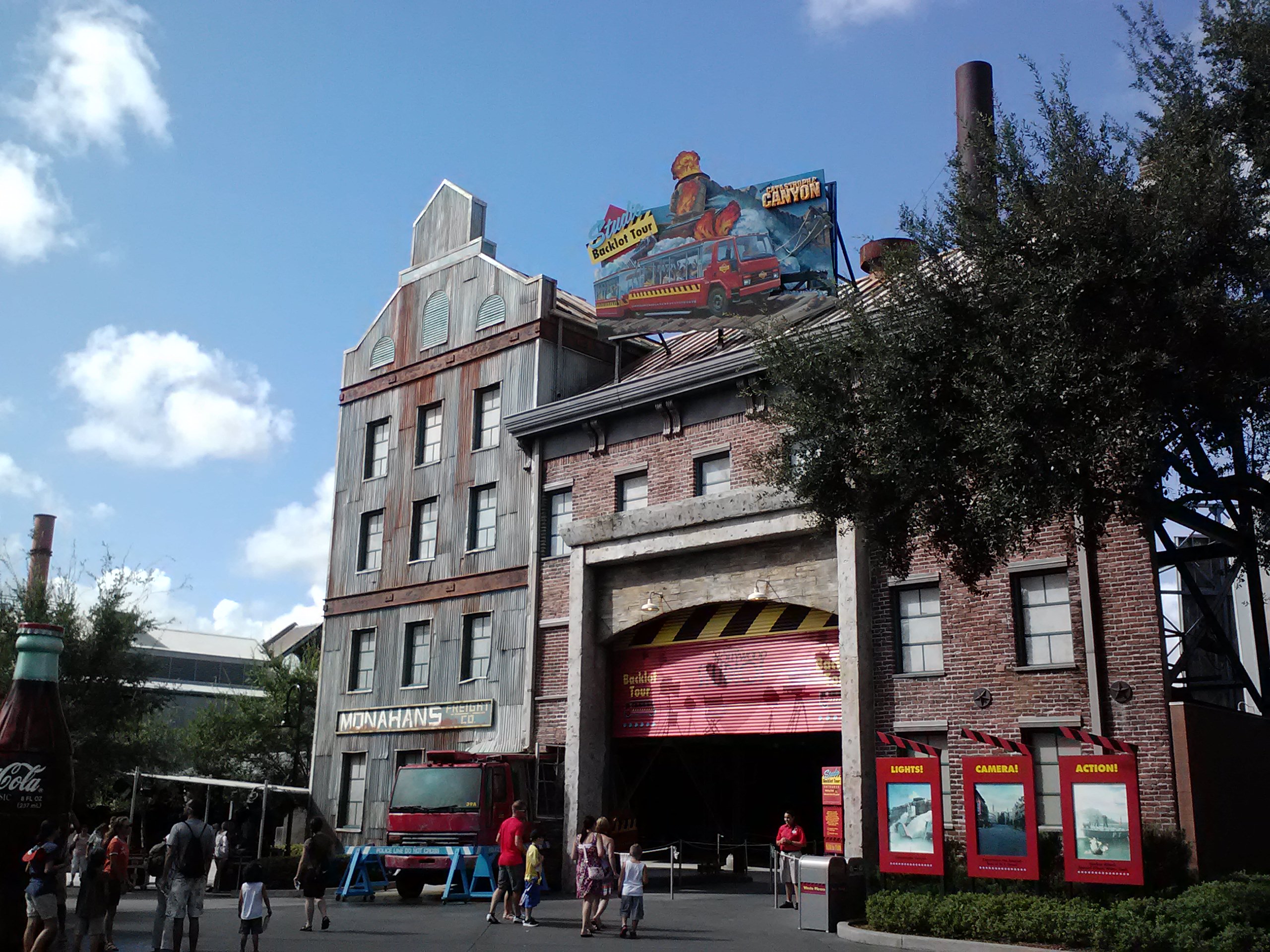
One of Walt Disney World's most historical attractions was the Tram Tour at the Studios park, one of only two "ride" attractions when Disney-MGM Studios opened in 1989. Over the years, it went through many formats and name changes before eventually becoming the Backlot Tram Tour. I got to ride it in 2014, its final year of operation. At the time, the ride's closure had not yet been announced, but I was somewhat aware that it was on borrowed time. When Hollywood Studios had opened that day, my Dad and I ran to Toy Story Mania, only to find it closed. At the end of our day at the park, I had the option to either ride that attraction or the Tram Tour. I never rode Midway Mania in 2014, but I definitely made the right choice... I can even recall the family in front of us talking about how Midway Mania was their favorite, and I was second-guessing my decision. :-o
File:Studio Backlot Tour marquee and entrance.jpg - Wikimedia Commons
Not my photo - but licensed for reuse!
The tour started out with a brief walking tour that used to be longer: there was a water effects pool where volunteers were called upon to show how water effects are juxtaposed in films, then you walked through a prop building. I remember being confused by this bit: what were these things for, and where did they come from? I still think that it's kind of random and haphazard, but I'm glad that Dad took a few pictures, as you can see some of the old EPCOT World of Motion animatronics in the rafters in one shot.
Props from the Rocketeer


World of Motion figures
The tram tour was a shell of what it once was, so my dad didn't take a ton of pictures. Here's one of the Earful Tower, the Hollywood Studios icon that was taken down in 2016.
Herbie the Love Bug - there was a "battered" version to the left.
Of course, props like these were the build-up to the only truly impressive thing on the Tram Tour, Catastrophe Canyon. First, though, you couldn't miss Walt Disney's airplane, used to scout the land that eventually become Walt Disney World.
File:Walt Disney's Airplane (N234MM) on the Studio Backlot Tour in ...
Not mine either

Catastrophe Canyon, Disney's attempt at a Universal-like special effects "disaster" show was pretty cool. I have a video clip to share if you are interested, though you probably have seen it somewhere.
Right behind Catastrophe Canyon was the Lights, Motors, Action Stunt Show. I did watch it on this visit, but I'm not sure if that show is well-enough respected to warrant a post. Turning around near the end of the Tour, we saw the Streets of America, which were only accessible by the tram in the park's very earliest days.
After the Tram Tour, there was an American Film Institute exhibit. My Dad is a big movie fan, so he took a bunch of pictures.
Indiana Jones whip
Lifeboat from Titanic


Axe from The Shining

I came away from the ride not very impressed but glad that I experienced it. When I got home, I watched some videos of the lengthy, original version, which gave me a better perspective on how the ride had evolved into its then-current state. Catastrophe Canyon was awesome and I would be picturing oil tankers tipping over and bursting into flames for months (instigated by collapsing telephone poles). ;-) I'm glad that I got to ride the Backlot Tram Tour and several other extinct Walt Disney World attractions that closed between this trip and my next in 2014, like Maelstrom, the Great Movie Ride, and Stitch's Great Escape, but I am still kicking myself for not seeing Universe of Energy! Thanks for reading.

Thursday, June 4, 2020

Roadside America

Roadside America, located in Shartlesville, Pennsylvania, was on my bucket list visit for years before I finally got there in 2018. The layout was the dream of one man, Laurence Gieringer, who worked on its hundreds of miniature buildings for years before finally displaying them for the public in 1935. In 1953, it opened in its current building, where it has operated ever since. Even though an interstate runs right by its front door, the nearest exit is a little down the road, making it somewhat of a hidden gem.
In Roadside America's brochures and billboards, just small details of the layout are shown, along with the slogan "Be prepared to see more than you expect." Once you enter the gift shop, there are no windows into the display whatsoever, not even on the door. However, there is a sign that states, "If you think this a trap, or a 'gip', so to speak, just ask anyone coming out, and they will tell you otherwise. " Then you push away the door and see this:
I had to steal this picture because my pictures have bad flash.
The scene when you step inside is truly jaw-dropping (if somewhat amplified by the rear mirror). Roadside America is 8,000 square feet, and it isn't until you go in for yourself do you become aware of its magnitude. Every one of these tiny buildings was handmade by one person. There are so many awesome details, from the working waterfall along the wall (go underneath and see a Luray Caverns mock-up) to the hundreds of tiny figures.
From the RA website
One of the cool things about the layout is observation decks that put you a good ten or so feet above the scenes.
 If you look at the bottom here, you can see some of the many push buttons that operate little movements around the layout. Oh yeah, and there're (O gauge) miniature trains too!
When Gieringer died in 1963, the display was preserved as-is and has been for more than 50 years. It is one of the closest things to a time capsule that you can get in a roadside attraction anywhere. It's even still owned by his extended family, although they are looking for an owner who can take it over for the future.
By far the most impressive moment of the Roadside America experience is the "Night Pageant," which occurs every half hour. The first warning is a muffled announcement over the loudspeaker, which you are only starting to decipher when the lights begin to dim and interior lights turn on in the little buildings. Projections of Jesus are juxtaposed against a waving American flag, and the pageant ends in an epic performance of "God Bless America" by Kate Smith. It's a kind of patriotism that you don't get anywhere anymore and is good for everyone once in a while. My favorite part is when right on cue with "from the mountains..." backlights light up right behind them along the wall!  The video doesn't do it justice. Okay, I'll stop rambling. Just get out to central PA and see it for yourself!

Note 11/2020: Roadside America permanently closed before this post was written in March 2020, although the closure was not announced until November.

Thursday, May 21, 2020

Amusement Park Art and Century Flyers

This is a little bit of a different post for here, but I hope that you still enjoy it! I'm not artistic whatsoever, but there are ways for even non-artistic people to make something that looks moderately okay, especially with computers and the ability to print out or create templates. In middle school art class, I took advantage of several "open-ended" art projects to make something as a tribute to some of my favorite amusement parks and attractions. No matter how crude these may be, I really enjoy having them as decorations.
This is my favorite, although it is admittedly super dorky. (Who am I kidding; the teacher or any of my friends probably had no idea what I was doing!) :-D Of course, these are the original symbols from EPCOT Center: the whole park with logo, CommuniCore, Living Seas, Imagination, Horizons, Land, Spaceship Earth, and World of Motion. The idea behind this project was to create "wind chimes," and the whole thing, about two feet tall, is made out of clay.
I made them by placing a piece of paper as an outline over the clay and then carving the shapes out, like Land and Imagination, or by adding material bas-relief style, like Spaceship Earth and the big symbol. I realize now that if I had switched Imagination and Living Seas, the arrangement would be the same as they actually are at the park! I forgot to put a hole in the World of Motion symbol, so that one doesn't hang with the rest. I wanted to include Universe of Energy, but I found it difficult to make concentric circles, so that piece got thrown away.
I'm a fan of these symbols because they aren't seen at the park today. With the reinvention of Epcot, Disney is planning to return some of them to Future World along with variants for the new attractions.
I cranked up the color a little bit on my 6th grade printmaking project of the Horizons symbol. The funny thing about this is that every kid gets to stick his or her stamp on a ceiling tile, so one of my Horizons symbols will be left behind for years to come on the school. I also made a multi-color printmaking sheet in 7th grade of Pretzel darkride cars.
Aside from Disney, I have made a couple tributes to my local amusement parks, as well. This is for the Blue Streak at Conneaut Lake Park in NW Pennsylvania. A cool logo was created for the ride's 75th anniversary in 2013 and placed on the station. Using "Perler Beads," which are small plastic beads that can be ironed together, I created a huge template of the logo, made of thousands of beads. It's more than two feet long, so I think that it's a miracle that I somehow didn't ruin this by spilling the beads over the months I worked on it at school.
Blue Streak is one of my favorite ever coasters. I love this ride so much that it's my profile pic. I like its story of survival, having been through many years of standing-but-not-operating status, and it is also such a quirky old ride. It's smooth, yet the bumps are different every go-around and really add to the experience. The classic trains that the ride operated with were given the factory name "Century Flyer" when they were manufactured in the mid-century. 
They are definitely relics from the time period, so I decided to make my own not-quite-proportionate tribute to the front headlight design, which is about half a foot by half a foot.
There were better days on the Blue Streak train when the headlights weren't busted out and the stainless steel was gleaming. Take this 1997 picture, found on a website of the American Coaster Enthusiasts.
Strangely, the three parks in the world that still run this style of train are all in PA and West Virginia. This is Kennywood's Thunderbolt, which has removed the center headlight altogether in exchange for the ride logo.

Still, though, the Century Flyer is my favorite roller coaster train ever. Okay, that's enough rambling about something unrelated for now. Thanks for reading!

Thursday, May 7, 2020

More Old Kennywood Postcards

Last post, we looked at the first set of my Kennywood postcards, so we're taking a glance at the rest of the good ones now.
The spelling of "Pittsburg" with no 'h' at the end dates this card of the park's Old Mill from before 1911, as it was between that year and 1890 that Pittsburgh was spelled that way. It's a long story. The Old Mill is arguably the oldest attraction at Kennywood, undergoing a wide variety of re-themes over 100+ years. It is scheduled to hopefully return under its original name for 2020.
"Dear Bertha: How are you all? I suppose you think we have forgotten you, but that would be impossible. We have moved now, and want you all to come up. Tell Aunt Mag and Mary to come along. Would like to see you all. Write soon."
The Old Mill was demolished and rebuilt in 1926, so the image shown here is not the current building.
 "Not to visit Kennywood is not to know Pittsburgh" is stated on the back of this card, even though Kennywood isn't technically in Pittsburgh! It's actually in West Mifflin, just outside of the city, but I get what they're trying to say here.
This card is my favorite, with its bright design and colorized illustrations. I would guess 1940s on its date. Looking clockwise, we have the Tower refreshment stand and the Sportland games building, both of which have been replaced with different structures but still serve the same purpose. You can see the miniature railroad entrance in the far background. Next is the Penny Arcade, which sadly has a newer building and facade now; but once again, it's still an arcade! The picture at the bottom is of the park's lagoon, which was once used for circus acts. Today, it's the loading area for a "Skycoaster" attraction. You can also glimpse the station of the park's wooden Racer coaster in the background.
Moving a little later on in time, we come to a Kennywood's 1986 Ferris wheel, the Wonder Wheel.
In 2001, the Wonder Wheel was replaced by Aero 360, a spinning, upside-down ride. George Ferris, the man who invented the first modern wheel, lived in Pittsburgh for many years, so it's unfortunate that the park no longer has a Ferris wheel of its own.
This verdant card shows paddle boats on the park's lagoon. Boats of some sort have been a fixture at Kennywood since its opening day. 
In 2019, the bridge and the lagoon area of the park as a whole were changed with the addition of Steel Curtain, a new roller coaster. I love the ride, but it unmistakably sticks out as out-of-scale in this area of Kennywood.
Steel Curtain has the most inversions out of any North American coaster, with nine.
Raging Rapids, which pumps 110,000 gallons of water a minute are through its trough, was added in 1985. The waterfall shown here is now no more, due to someone suing the park because he claimed he got an "eye-eating parasite" from it. No comment.
This card shows some of Kennywood's kiddie rides, mainly the Lil' Phantom kiddie coaster, which holds a special place in my heart, as it was my first coaster. The "Dumbo" (officially named "Elephant Parade") and "Red Baron" rides shown along the bottom are the exact same in execution, and Kennywood added a third variant of this system in Thomas Town in 2018. I guess that they're just trying to pretend to be Magic Kingdom...
Last for today is my final antique postcard, although it's not of Kennywood but of Pittsburgh's other major amusement park, West View. This view shows a roller coaster, the carousel, a bandstand, and the pony track. West View Park closed in 1977.
"Dear Paul, I am writing you a few lines to let you know that I am well. I am working full power. I am in Ambridge, Pa. I am sending my best regards to the family. My address is 814 - 18th St. Ambridge, Pa."
I hope that you've enjoyed this compilation of classic Kennywood postcards!

Wednesday, April 22, 2020

Kennywood Postcards - Then and Now!

I have gained a small collection of Kennywood postcards within the last few years, so I thought that it would be a fun time to look back at a few of them! Some are older than others, but I like them all. I will also be attaching the back of the postcards when they have messages, as it's cool to read these impressions from the era... some are related to the park, but most are not. I got the oldest of these at a little transportation museum in the northwestern Pennsylvania countryside for only a few bucks apiece. I was thrilled to see a rack of old cards there, and the owner was once a Kennywood employee himself in the 1960s.
Let's start at the very beginning of the park's history. As the postmark below shows, this card was written in 1912!

"We have had April, May, March and December all squeezed into the last 24 hours. This surely has been "some winter." Am en route for Shakespeare, thence to grant, to Mr. Georgis and this evening we take in the (?) Auto show. That ought to fill up my holiday alright. Geo. has the machine torn to peices (sic.) and I am going to give him a lift. The boulevard is not any too good for Mr. P or me, if you please. - E.M.S." Pretty great stuff! "The machine" - that's 1912 for you!
Well, that tells us nothing about Kennywood, but given that this card was sent in February, who knows if the writer ever visited the park. The cool thing is that both of the buildings shown are miraculously still in the park today! The Parkside Cafe, then known as the Casino (though it was never a gambling hall...) is seen in the foreground. Here's the same side of that 1900 (!!) building now, although this is facing in the opposite direction compared to the view on the card. Both levels have been enclosed, but it's otherwise remarkably similar to back then.
In the background, you can barely make out the park's original carousel building. This is the only park structure from Kennywood's opening year, 1899, still intact today. The first two Kennywood carousels were in this structure, but when the park gained its current, much larger model in 1927, it necessitated a larger building. The original pavilion then became a food stand.  Later, it was enclosed and turned into a Johnny Rocket's in 2014.
Next up is the massive Kennywood swimming pool, seen in this card postmarked 1938. From 1925 to 1973, Kennywood had this 350 x 180 ft pool, capable of holding 2.25 million gallons of water and 4,500 swimmers. Its large size led to excessive maintenance costs, causing the pool's closure after the 1973 season, when it was turned into a parking lot. It remained that way until 1995, which marked the opening of the 6-acre Lost Kennywood, a tribute to closed amusement parks through turn-of-the-century architecture and the largest expansion in Kennywood history.

"Pittsburgh Promotes Progress"
"Dear Maryon, When are you going to write me? I was expecting a letter a couple of weeks ago. Anyway, I am sending this postcard with the picture of the swimming pool I go to. It's at Kennywood Park. I go to our school picnic to another one there (?) times a year""
Kennywood included a rough replica of the pool fountain shown in this card when Lost Kennywood was built in 1995.
I purchased this card in one of the park's gift shops very recently, and it's a genuine old card. It has to be at least 25 years old, and I'm betting that it might be older. The Enterprise opened at Kennywood in 1978, and you can clearly see that from its decorations!
 In 2003, the Enterprise became the Volcano when the surrounding area was lightly re-themed into "Volcano Valley." It was plagued with problems, though, and I only ever saw this model operating (and rode it) once before it was removed in 2016. That season, Kennywood received an identical model from Lake Compounce, one of their "sister parks," as they were removing theirs to add a coaster. It remains at the park now and is open every day once again.

Last up for today is this semi-current collage of four of Kennywood's classic attractions: the Turtle (1927; one of 2 left in the world), Jack Rabbit (1920; famous for its "double dip"), miniature train (1945; came from 1939-40 New York's World's Fair), and Auto Race (1930; the last of its kind). 
All of these attractions still operate, but the miniature train was turned into "Journey with Thomas" in 2018. The framework of the two locomotives was kept, but one was refitted.
Yeah... I'm not a fan.
On that note, I hope you've enjoyed this trip through Kennywood history!